• Overview
    • English (Global)
    • 日本語 (Japan)
  • Control Theory
  • Python
  • TwinCAT
  • Profile
  • Training
    • English (Global)
    • 日本語 (Japan)
  • English (Global)
  • 日本語 (Japan)
  1. Python
  2. Python library: pylib-sakata
  3. Function manual of traj
  • Python

    • Environment Setup
      • How to create a Python virtual environment
      • Python IDE Installation Guide

    • Python library: pylib-sakata
      • Setup of pylib-sakata
      • Function manual of ctrl
      • Function manual of fft
      • Function manual of meas
      • Function manual of traj
      • Function manual of plot
      • Function manual of init

    • Simulation
      • Precise Time-Domain Simulation of High-Order LTI Systems

On this page

  • pylib_sakata.traj
    • TrajInf
    • traj3rd
    • traj3rd2
    • traj4th
    • trajSinStep
  1. Python
  2. Python library: pylib-sakata
  3. Function manual of traj

Function manual of traj

pylib_sakata.traj

TrajInf

class pylib_sakata.traj.TrajInf(time, pos, vel, acc, T, dt)

  • Parameters:
    • time: 1-D array time data [s]
    • pos: 1-D array position trajectory data [m]
    • vel: 1-D array velocity trajectory data [m/s]
    • acc: 1-D array acceleration trajectory data [m/s^2]
    • T: moving time [s]
    • dt: sampling time of the trajectory data

traj3rd

pylib_sakata.traj.traj3rd(posStart, posStep, velMax, accAve, dt, Tstay=0)

This function is for generation of a 3rd order polynomial trajectory.

  • Parameters:
    • posStart: start position of the trajectory
    • posStep: step position of the trajectory
    • velMax: maximum of velocity of the trajectory
    • accAve: average of accelation (= decelation) of the trajectory
    • dt: sampling time of the trajectory data.
    • Tstay: time after the step moving
  • Returns:
    • out: instance of TrajInf class of the 3rd order polynomial trajectory

Examples

traj = traj.traj3rd(0, 100, 100, 200, 0.001, 0.5)

traj3rd2

pylib_sakata.traj.traj3rd2(posStart, posStep, velMax, accAve, jerkRatio, dt, Tstay=0)

This function is for generation of a 3rd order polynomial trajectory as trapezoidal accelaration trajectory.

  • Parameters:
    • posStart: start position of the trajectory
    • posStep: step position of the trajectory
    • velMax: maximum of velocity of the trajectory
    • accAve: average of accelation (= decelation) of the trajectory
    • jerkRatio: ratio of jerk time per accelaration time (0 < jerkRatio <= 0.5)
    • dt: sampling time of the trajectory data.
    • Tstay: time after the step moving
  • Returns:
    • out: instance of TrajInf class of the 3rd order polynomial trajectory

Examples

traj = traj.traj3rd2(0, 100, 100, 200, 0.001, 0.2, 0.5)

traj4th

pylib_sakata.traj.traj4th(posStart, posStep, velMax, accAve, dt, Tstay=0)
pylib_sakata.traj.traj4th2(posStart, posStep, velMax, accAve, dt, Tstay=0)

This function is for generation of a 4th order polynomial trajectory.

  • Parameters:
    • posStart: start position of the trajectory
    • posStep: step position of the trajectory
    • velMax: maximum of velocity of the trajectory
    • accAve: average of accelation (= decelation) of the trajectory
    • dt: sampling time of the trajectory data.
    • Tstay: time after the step moving
  • Returns:
    • out: instance of TrajInf class of the 4th order polynomial trajectory

Examples

traj = traj.traj4th(0, 100, 100, 200, 0.001, 0.5)

trajSinStep

pylib_sakata.traj.trajSinStep(posStart, posStep, velMax, accAve, dt, Tstay=0) pylib_sakata.traj.trajSinStep2(posStart, posStep, velMax, accAve, dt, Tstay=0) pylib_sakata.traj.trajSinStep3(posStart, posStep, velMax, accAve, dt, Tstay=0)

This function is for generation of a trajectory based on sine waves.

  • Parameters:
    • posStart: start position of the trajectory
    • posStep: step position of the trajectory
    • velMax: maximum of velocity of the trajectory
    • accAve: average of accelation (= decelation) of the trajectory
    • dt: sampling time of the trajectory data.
    • Tstay: time after the step moving
  • Returns:
    • out: instance of TrajInf class of the trajectory based on sine waves

Examples

traj = traj.SinStep(0, 100, 100, 200, 0.001, 0.5)

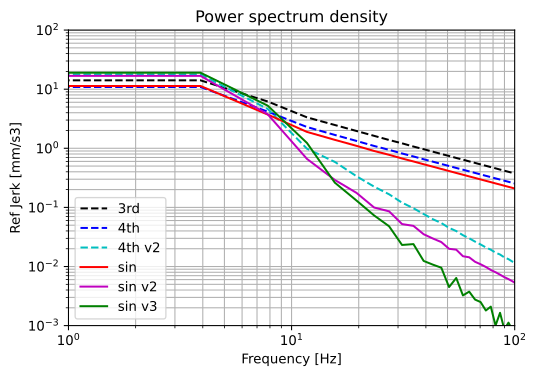
The comparison of these trajectories under the specification: posStep = 1, velMax = 1, accAve = 2 is shown as follows.

import numpy as np
from pylib_sakata import ctrl
from pylib_sakata import traj
from pylib_sakata import fft
from pylib_sakata import plot

print('Start simulation!')

# Common parameters
Ts = 1/8000
dataNum = 10000
freqrange = [1, 1000]
freq = np.logspace(np.log10(freqrange[0]), np.log10(freqrange[1]), dataNum, base=10)
s = ctrl.tf([1, 0], [1])
z = ctrl.tf([1, 0], [1], Ts)
print('Common parameters were set.')

print('Time response analysis is running...')
posStep = 1
velMax = 1
accAve = 2

traj0 = traj.traj3rd(0, posStep, velMax, accAve, Ts)
traj1 = traj.traj4th(0, posStep, velMax, accAve, Ts)
traj2 = traj.traj4th2(0, posStep, velMax, accAve, Ts)
traj3 = traj.trajSinStep(0, posStep, velMax, accAve, Ts)
traj4 = traj.trajSinStep2(0, posStep, velMax, accAve, Ts)
traj5 = traj.trajSinStep3(0, posStep, velMax, accAve, Ts)

freq_fft0, jerk0_fft = fft.fft_ave(traj0.jerk, Ts)
freq_fft1, jerk1_fft = fft.fft_ave(traj1.jerk, Ts)
freq_fft2, jerk2_fft = fft.fft_ave(traj2.jerk, Ts)
freq_fft3, jerk3_fft = fft.fft_ave(traj3.jerk, Ts)
freq_fft4, jerk4_fft = fft.fft_ave(traj4.jerk, Ts)
freq_fft5, jerk5_fft = fft.fft_ave(traj5.jerk, Ts)

print('Plotting figures...')
# Time response
fig = plot.makefig(dpi=400, figsize=(12, 12))
ax1 = fig.add_subplot(511)
ax2 = fig.add_subplot(512)
ax3 = fig.add_subplot(513)
ax4 = fig.add_subplot(514)
ax5 = fig.add_subplot(515)
plot.plot_xy(ax1, traj0.time, traj0.pos, '--', 'k', 1.5, 1.0, legend='3rd')
plot.plot_xy(ax1, traj1.time, traj1.pos, '--', 'b', 1.5, 1.0, legend='4th')
plot.plot_xy(ax1, traj2.time, traj2.pos, '--', 'c', 1.5, 1.0, legend='4th v2')
plot.plot_xy(ax1, traj3.time, traj3.pos, '-', 'r', 1.0, 1.0, legend='sin')
plot.plot_xy(ax1, traj4.time, traj3.pos, '-', 'm', 1.0, 1.0, legend='sin v2')
plot.plot_xy(ax1, traj5.time, traj5.pos, '-', 'g', 1.0, 1.0, ylabel='Pos [m]', title='Time response', legend='sin v3')
plot.plot_xy(ax2, traj0.time, traj0.vel, '--', 'k', 1.5, 1.0)
plot.plot_xy(ax2, traj1.time, traj1.vel, '--', 'b', 1.5, 1.0)
plot.plot_xy(ax2, traj2.time, traj2.vel, '--', 'c', 1.5, 1.0)
plot.plot_xy(ax2, traj3.time, traj3.vel, '-', 'r', 1.0, 1.0)
plot.plot_xy(ax2, traj4.time, traj4.vel, '-', 'm', 1.0, 1.0)
plot.plot_xy(ax2, traj5.time, traj5.vel, '-', 'g', 1.0, 1.0, ylabel='Vel [m/s]')
plot.plot_xy(ax3, traj0.time, traj0.acc, '--', 'k', 1.5, 1.0)
plot.plot_xy(ax3, traj1.time, traj1.acc, '--', 'b', 1.5, 1.0)
plot.plot_xy(ax3, traj2.time, traj2.acc, '--', 'c', 1.5, 1.0)
plot.plot_xy(ax3, traj3.time, traj3.acc, '-', 'r', 1.0, 1.0)
plot.plot_xy(ax3, traj4.time, traj4.acc, '-', 'm', 1.0, 1.0)
plot.plot_xy(ax3, traj5.time, traj5.acc, '-', 'g', 1.0, 1.0, ylabel='Acc [m/s2]')
plot.plot_xy(ax4, traj0.time, traj0.jerk, '--', 'k', 1.5, 1.0)
plot.plot_xy(ax4, traj1.time, traj1.jerk, '--', 'b', 1.5, 1.0)
plot.plot_xy(ax4, traj2.time, traj2.jerk, '--', 'c', 1.5, 1.0)
plot.plot_xy(ax4, traj3.time, traj3.jerk, '-', 'r', 1.0, 1.0)
plot.plot_xy(ax4, traj4.time, traj4.jerk, '-', 'm', 1.0, 1.0)
plot.plot_xy(ax4, traj5.time, traj5.jerk, '-', 'g', 1.0, 1.0, xlabel='Time [s]', ylabel='Jerk [m/s3]')
plot.plot_xy(ax5, traj1.time, traj1.snap, '--', 'b', 1.5, 1.0)
plot.plot_xy(ax5, traj2.time, traj2.snap, '--', 'c', 1.5, 1.0)
plot.plot_xy(ax5, traj3.time, traj3.snap, '-', 'r', 1.0, 1.0)
plot.plot_xy(ax5, traj4.time, traj4.snap, '-', 'm', 1.0, 1.0)
plot.plot_xy(ax5, traj5.time, traj5.snap, '-', 'g', 1.0, 1.0, xlabel='Time [s]', ylabel='Snap [m/s4]')

# FFT
fig = plot.makefig(dpi=200)
ax1 = fig.add_subplot(111)
plot.plot_xy(ax1, freq_fft0, jerk0_fft, '--', 'k', 1.5, 1.0, title='Power spectrum density', legend='3rd')
plot.plot_xy(ax1, freq_fft1, jerk1_fft, '--', 'b', 1.5, 1.0, title='Power spectrum density', legend='4th')
plot.plot_xy(ax1, freq_fft2, jerk2_fft, '--', 'c', 1.5, 1.0, title='Power spectrum density', legend='4th v2')
plot.plot_xy(ax1, freq_fft3, jerk3_fft, '-', 'r', 1.5, 1.0, title='Power spectrum density', legend='sin')
plot.plot_xy(ax1, freq_fft3, jerk4_fft, '-', 'm', 1.5, 1.0, title='Power spectrum density', legend='sin v2')
plot.plot_xy(ax1, freq_fft4, jerk5_fft, '-', 'g', 1.5, 1.0, xscale='log', yscale='log', xrange=[1.0, 100.0], yrange=[0.001, 100], xlabel='Frequency [Hz]', ylabel='Ref Jerk [mm/s3]', legend='sin v3')

plot.showfig()
print('Finished.')
Start simulation!
Common parameters were set.
Time response analysis is running...
Plotting figures...

Finished.

© 2026 Koichi Sakata

Built with Quarto

  • Privacy Policy